Imagine you need to move quickly from a price alert to execution: your phone buzzes, you open the OKX app, and you must log in, confirm a trade, and—if you’re trying to bridge into a Layer 2—shift funds into a Web3 wallet. That short sequence hides several distinct systems and security trade-offs: the centralized exchange layer that holds custody and offers derivatives, and the non‑custodial Web3 layer where you control private keys and interact with DApps. Understanding how OKX stitches those layers together — and where the failure modes lie — matters for anyone trading from the US who wants speed without sacrificing control.
This article explains the mechanisms behind OKX’s hybrid model: how account login and protection work; how the non‑custodial Web3 wallet differs from your exchange account; what the DEX aggregator and cross‑chain tools actually do; and the main limitations US traders should keep in mind. I’ll also flag a few decision heuristics you can reuse the next time you decide whether to keep assets on the CEX or move them into a self‑custodial wallet.
Layered mechanics: CEX login vs Web3 wallet — what’s actually different
At the protocol level there are two distinct trust relationships. Your OKX account (the centralized side) is an identity and custody construct: you authenticate via credentials and KYC, and OKX holds the private keys for assets you deposit. By contrast, the OKX Web3 wallet is non‑custodial: the user generates and stores a seed phrase that equals control of the private keys. Mechanically this means different failure modes. If you lose access to your OKX account, there are regulatory and customer‑support pathways (KYC recovery, identity checks). If you lose a seed phrase, there is no central authority to recover it—loss is permanent.
Login protection on the CEX side layers multiple defenses: mandatory KYC for US users, two‑factor authentication (SMS, Google Authenticator, or biometrics on mobile), and AI‑driven real‑time threat detection to block suspicious sessions. These features reduce some classes of remote compromise. Yet they do not eliminate phishing or SIM swap risks—attacks adapt. For that reason, the simplest useful rule for traders is: keep liquid trading balances on the exchange only for the time you need them; move larger, longer‑term holdings to a hardware‑protected Web3 wallet that you control.
How the OKX DEX aggregator and cross‑chain transfers work in practice
OKX’s DEX aggregator is a routing layer: when you request a token swap it queries liquidity pools across multiple decentralized exchanges (Uniswap and similar) and computes the cheapest route after fees and slippage. For cross‑chain transfers, the aggregator uses bridges or wrapped representations to move value between networks. Mechanically, aggregation reduces slippage and improves execution price compared with swapping on a single low‑liquidity pool, but it can increase smart contract complexity and on‑chain gas costs.
For a US trader, the key trade‑off is execution versus exposure. Using the CEX’s internal matching engine for spot trades typically gives faster fills and cheaper overhead for high‑volume assets (BTC, ETH, major stablecoins). Using the DEX aggregator is useful for obscure tokens or for DeFi strategies that require direct wallet-to‑contract interaction. But remember: interacting with DEXs and bridges exposes you to smart contract risk and potential regulatory ambiguity around token provenance—factors that matter if you need to comply with reporting or freeze requirements.
If you want a quick route to login and start trading, the exchange’s login flow is the natural starting point. For instructions on the exact login screens and support pages that can help with initial setup, the following resource is practical and mirrors the steps described above: https://sites.google.com/cryptowalletextensionus.com/okx-login-web/
Security architecture and the hard limits of protection
OKX stores over 95% of customer assets in air‑gapped cold wallets protected by multi‑signature schemes. This reduces the risk of mass online theft but does not eliminate user‑level attack vectors: phishing, device compromise, or social engineering. On the Web3 side, hardware wallet integrations (Ledger, Trezor) materially lower the risk of key exfiltration—because signing happens off‑device—but they add friction to routine trades and require safe seed phrase custody.
Proof of Reserves (PoR) provides an on‑chain transparency signal: you can verify that the exchange holds assets backing user deposits. PoR improves trust compared with opaque balance sheets, yet it is not a panacea. PoR snapshots are moments in time; they don’t prove ongoing solvency if an exchange has undisclosed liabilities, off‑chain exposures, or opaque derivatives positions. In short: PoR raises the floor of transparency but does not eliminate counterparty risk.
Trading tools, product breadth, and where the platform stretches thin
OKX offers a broad product set: spot, margin up to 10x, futures and derivatives up to 125x on certain products, staking, yield farming, NFTs, and a Web3 wallet tied to thousands of DApps. That breadth is valuable: a single interface reduces context switching when you move from spot to options to staking. But breadth increases complexity. For US traders, regulatory constraints mean certain derivatives markets and token pairs may be unavailable; product availability is conditional on local rules and periodic delisting decisions—recently OKX removed several spot pairs as part of routine cleansing of low‑activity listings. That delisting behavior is normal for exchanges trying to keep order books healthy, but it highlights a practical risk: thin assets you hold might be harder to liquidate quickly or might be removed entirely.
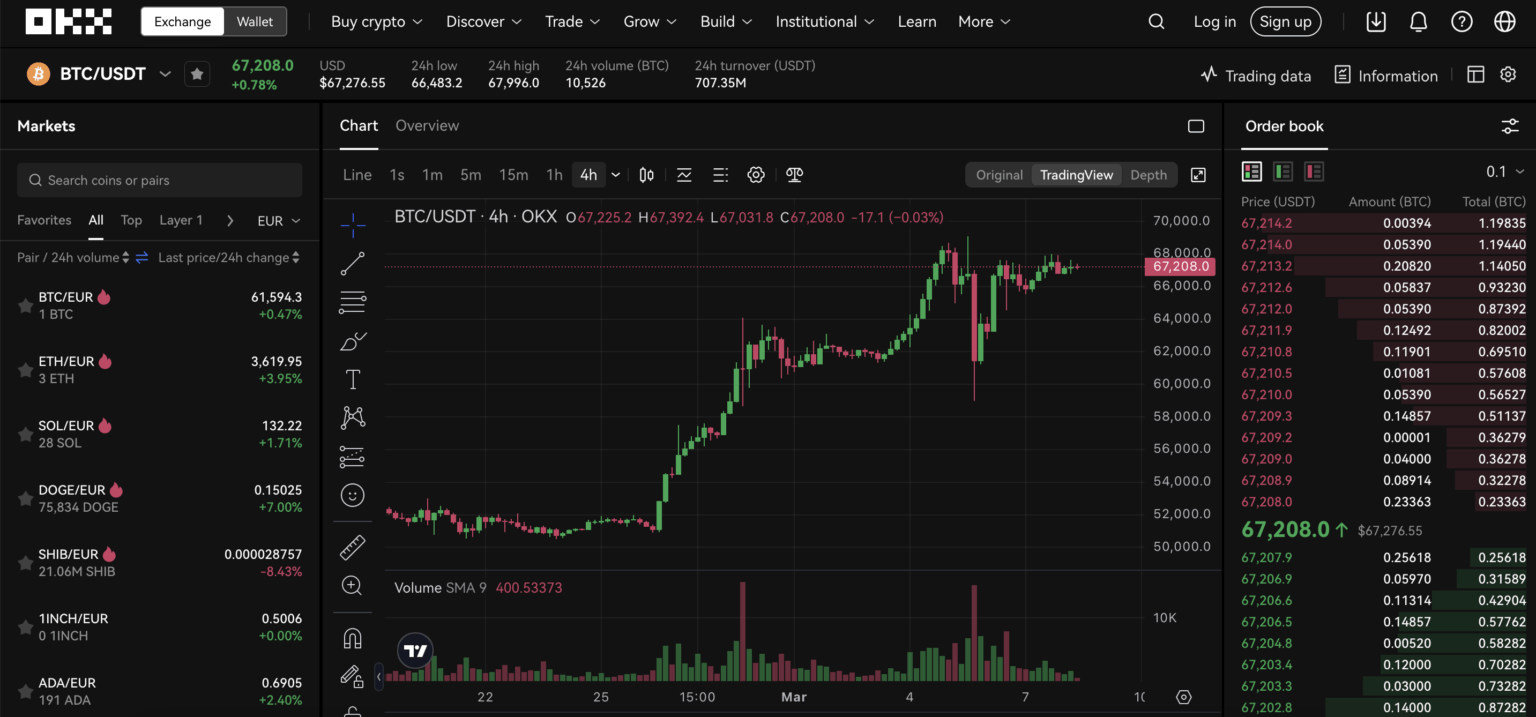
Operationally, the platform is cross‑channel: advanced TradingView charts on the web, biometric mobile logins, and a browser extension for Web3. Relying on multiple entry points is convenient but enlarges the attack surface. A pragmatic trader checklist: keep strong, unique passwords; enable hardware 2FA where possible; tie your primary 2FA to an authenticator app rather than SMS; and compartmentalize funds—small operational balances on the exchange, larger holdings in a hardware wallet.
Decision heuristics: when to use the exchange, when to use the Web3 wallet
Here are three reusable heuristics for US traders weighing custody and execution:
1) Time‑horizon heuristic: if you need funds to trade intraday or enter fast derivatives positions, keep them on the exchange. For anything beyond days, prefer custody you control (hardware wallet) to reduce systemic counterparty exposure.
2) Liquidity heuristic: for high‑liquidity majors, centralized matching is usually cheaper and faster. For obscure tokens or DeFi strategies that require contract interactions (yield farming, staking in DApps), use the Web3 wallet but accept higher operational risk.
3) Risk‑budget heuristic: quantify how much you can tolerate in each risk bucket (counterparty, smart contract, custody loss). Allocate capital accordingly. Example: if you’re risk‑averse to counterparty failure, limit on‑exchange exposure to an amount you could cover by other means if the exchange froze withdrawals.
Where the system breaks and what to watch next
The system’s most visible failure modes are human and regulatory. Phishing remains the most common vector that bypasses technical protections because it targets credentials and 2FA. Smart contract exploits on the DeFi side are unpredictable; even well‑audited code can be vulnerable to unseen composability flaws. Regulatory changes in the US could affect derivatives availability, KYC stringency, reporting obligations, or how exchanges list assets. Traders should watch three signals: delisting notices (which indicate liquidity and compliance pressures), changes to KYC or identity verification policies, and PoR cadence or methodology updates—each signal alters the balance of custodial trust.
Because exchanges periodically adjust listings to maintain a robust trading environment, the removal of low‑liquidity pairs is expected behavior rather than a warning sign by itself. Still, for assets you hold that look thin, maintain an exit plan. That plan can be simple: set limit orders to avoid slippage, or move a small portion of your position into a more liquid on‑exchange asset ahead of any potential delisting announcement.
FAQ
Do I need KYC to use OKX from the US?
Yes. For US users, Know Your Customer (KYC) verification is required to comply with AML rules. Expect to submit government‑issued ID and complete a facial liveness check. KYC enables account recovery pathways that don’t exist for non‑custodial wallets, but it also ties your identity to on‑chain activity reported through platform records.
What happens if a token I hold is delisted?
Delisting usually follows a notice period. Exchanges often disable new deposits first, then remove spot pairs when liquidity is low. You can typically withdraw delisted assets to a wallet or another exchange, but delisting can increase spreads and reduce price transparency. For thin tokens, plan withdrawals ahead of delisting announcements where possible.
Is OKX’s Proof of Reserves a full guarantee?
No. Proof of Reserves provides visible evidence of on‑chain holdings at snapshots and improves transparency. It does not prove the absence of off‑chain liabilities, operational losses, or complex derivatives exposures. Treat PoR as a helpful signal, not an absolute guarantee.
Should I connect my OKX Web3 wallet to DApps?
Only when necessary, and only after confirming the contract addresses and permissions. DApp interactions expose you to smart contract risk and potential token approvals that allow contracts to move assets. Use hardware wallets for high‑value interactions and revoke unnecessary approvals periodically.
Practical takeaway: treat OKX as a dual‑track platform. Use the exchange for efficient market access, derivatives, and short‑term liquidity; use the Web3 wallet for self‑custody, DeFi interactions, and long‑term holdings. Each choice trades off speed, cost, and exposure to different classes of risk. For step‑by‑step login guidance and a walkthrough of the login screens that mirror the mechanics discussed here, visit the platform help resource at https://sites.google.com/cryptowalletextensionus.com/okx-login-web/.
Finally, remember the pragmatic posture that serves traders best: skepticism combined with procedures. Question convenience when it increases exposure, and document recovery paths for both exchange accounts and self‑custodial keys. That combination—careful habit formation plus a clear decision heuristic—turns platforms like OKX from opaque black boxes into composable tools you can manage.